
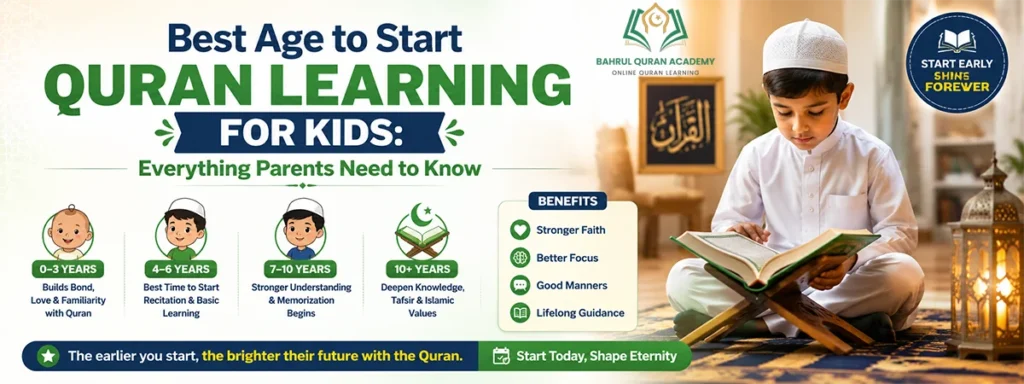
Best Age to Start Quran Learning for Kids: Everything Parents Need to Know
As a parent, one of the most meaningful decisions you will make is choosing the best age to start Quran learning for kids. Many families wonder whether their child is ready at age three, five, or seven — and whether starting too early or too late could affect progress. The truth is that every child’s readiness looks slightly different. However, research in child development and Quran learning consistently points to the early years as a golden window of opportunity.
This guide gives you a clear, age-by-age breakdown of Quran learning for kids — from listening to short surahs as toddlers to mastering Tajweed basics for children in primary school. Whether you are based in the UK, USA, Canada, Australia, or Pakistan, you will find practical advice here to support your child’s Quran education at every stage. We also explain how children’s Quran classes with qualified online teachers can make this journey structured, enjoyable, and deeply rewarding for the whole family.
When Should Children Start Their Quran Learning Journey?
Many parents ask: when should kids start Quran? The short answer is: earlier than most families think. Children’s brains are remarkably receptive to language between the ages of two and seven. This is the same period when language acquisition in early childhood is at its peak. Taking advantage of this window means your child can absorb Arabic sounds, letter shapes, and Quranic vocabulary far more naturally than they would later in life.
That said, formal Quran reading instruction is typically introduced around age four to five. Before that, listening to Quran from an early age and exposure to short surahs at home lays a strong foundation. The ideal age to learn Quran in a structured way is generally considered to be between four and seven — but informal engagement can and should begin from birth.
Signs Your Child Is Ready for Quran Lessons
Every child is unique, so readiness matters more than strict age. Here are practical signs that your child may be ready for age to start Quran classes for children:
- They can sit and focus for five to ten minutes at a time
- They recognise and repeat sounds clearly
- They show curiosity about letters or books
- They can follow simple two-step instructions
If your child shows these signs before age five, early beginner Quran course for kids sessions of ten to fifteen minutes can work beautifully.
How to Know When Your Child Is Ready to Learn the Quran
Quran reading readiness is closely linked to general reading readiness. Children who recognise shapes, enjoy listening to stories, and can hold a pencil comfortably are often well-positioned to begin. However, even children who are not yet reading in their first language can begin with Quran classes for kids that focus on listening, repetition, and memorisation — skills that come naturally to young children.
The Benefits of Introducing Quran Learning at an Early Age
Early Quran education offers benefits that reach far beyond religious knowledge. Studies in cognitive development show that children who learn a second language — including Arabic — before age seven develop stronger memory, concentration, and problem-solving skills. Teaching Quran to kids at a young age therefore supports their overall academic development, not just their faith.
In addition, building a daily Quran study at home habit during the early years creates a rhythm that stays with children into adulthood. Habit formation in children is most effective between the ages of three and eight, making this period ideal for establishing a consistent, joyful relationship with the Quran.
Language Acquisition and Arabic Pronunciation
Young children are natural mimics. They absorb pronunciation of Arabic letters with remarkable accuracy when exposed early and consistently. This is why starting Quran education early produces noticeably stronger Arabic recitation skills than beginning in the teenage years. The tongue becomes familiar with sounds that are unique to Arabic — such as the Qaf, Ain, and Ghayn — when trained during childhood.
For this reason, early Quran education that begins with listening, then moves to letter recognition, and then to guided reading tends to produce the most fluent and confident reciters.
Building Faith Foundations That Last a Lifetime
Islamic education for children during formative years creates deep emotional connections with the Quran. Children who grow up reciting short surahs, hearing the rhythm of Quranic verses, and understanding basic meanings are more likely to maintain their faith through adolescence. This faith foundation for kids is one of the most lasting gifts a parent can give.
A Step-by-Step Guide to Quran Learning by Age
Understanding Quran learning milestones by age helps parents set realistic expectations and celebrate every step of progress. Below is a practical guide covering the key stages of gradual Quran learning from toddlerhood through primary school.
| Age Group | Focus Area | Key Milestone |
|---|---|---|
| Ages 3–5 | Listening & Arabic alphabet recognition | Familiarity with short surahs and basic Arabic sounds |
| Ages 5–7 | Noorani Qaida & letter joining | Reading simple Arabic words with guidance |
| Ages 7–10 | Tajweed rules & Hifz | Reciting correctly and memorising short surahs independently |
Ages 3–5: Building Familiarity Through Quran Listening and Arabic Letters
At this stage, formal reading is not the goal. Instead, Quran learning for young children focuses on exposure and comfort. Parents can play Quran recitations during daily routines — at mealtimes, during car journeys, or at bedtime. This listening to Quran from an early age approach makes the sounds familiar and beloved.
Simple activities such as tracing Arabic alphabet for kids flashcards and repeating short phrases after a teacher introduce the building blocks without pressure. Children at this age learn through play and repetition, so age-appropriate Quran lessons keep sessions short (ten to fifteen minutes) and engaging.
Ages 5–7: Starting Noorani Qaida and Basic Quran Reading Skills
This is the ideal age to start Noorani Qaida for most children. The Noorani Qaida is a structured primer that teaches Arabic letter recognition, pronunciation, vowel sounds, and letter joining. It is the essential first step before a child attempts to read the Quran directly.
Noorani Qaida for beginners typically takes six to twelve months to complete, depending on the child’s pace and lesson frequency. Children who complete Noorani Qaida correctly can move into basic Quran recitation for children with far greater confidence and accuracy. This stage builds the muscle memory and phonetic awareness that supports all future learning.
Ages 7–10: Learning Tajweed Rules and Memorising Short Surahs
By age seven, most children have the focus and reading ability needed for Tajweed basics for children. Tajweed refers to the rules of correct Quran recitation — including how to elongate vowels, merge letters, and apply proper breath control. Learning Tajweed at this age means the rules become second nature.
Alongside Tajweed, many children begin Quran memorization for children of the shorter surahs in Juz Amma. Short surahs for kids such as Surah Al-Fatiha, Al-Ikhlas, and Al-Kawthar are ideal starting points. The best time to start Quran memorization in a structured way is generally agreed to be between seven and nine years old, when working memory is developing rapidly.
Supporting Every Child’s Quran Learning Journey with Qualified Teachers
One of the most important decisions a parent makes is choosing the right teacher. A qualified, experienced Quran teacher does not simply correct mistakes — they build confidence, adapt to each child’s Quran learning pace, and create a positive association with Islamic learning that lasts a lifetime.
Online Quran teachers can be particularly effective because they allow children to learn from the comfort and safety of home. Learn Quran online for kids through structured one-to-one or small group sessions means no commuting, consistent scheduling, and access to highly qualified teachers regardless of your location.
Age-Specific Quran Lessons Tailored to Children’s Learning Needs
Every child is different. Some children at age five are ready for Noorani Qaida; others benefit from another six months of listening and letter exposure. Therefore, age-specific Quran lessons that are tailored to the individual child — rather than rigidly based on age — produce the best outcomes.
A skilled teacher will conduct an initial assessment, identify where the child currently is, and design a personalised learning path. This approach removes pressure from both the child and the parent, replacing it with a clear and achievable plan.
Monitoring Progress and Creating Personalised Learning Goals
Parents should expect regular feedback from their child’s Quran teacher. Progress monitoring in Muslim child education is not just about what the child can recite — it includes confidence, consistency, and comprehension of basic meanings. Good programmes provide monthly or bi-weekly progress reports so parents can celebrate achievements and address any areas needing support.
Quran learning milestones by age are useful benchmarks, but personalised goals matter more. A child who joins at age six having never studied Arabic needs a different roadmap from a child who has already completed half of Noorani Qaida.
Success Stories from Parents Whose Children Learn with Us
Parents from the UK, USA, Canada, Australia, and Pakistan regularly share how their children have transformed through consistent, qualified Quran instruction. A mother from London shared that her seven-year-old went from being unable to recognise a single Arabic letter to reciting Surah Al-Fatiha with correct Tajweed in just four months. A father from Chicago described how his five-year-old now asks for her Quran lesson before school — a habit the whole family cherishes.
These results are not exceptional. They are what happens when the Quran learning pace for each child is respected, the teacher is qualified, and the environment is encouraging.
What Children Learn in Our Beginner Quran Programme
Our beginner programme is built specifically around the best age to start Quran learning for kids — from toddlers taking their first steps with Arabic sounds to older children refining their recitation and beginning memorisation. Every element of the curriculum is designed to be age-appropriate, engaging, and academically sound.
Developing Strong Arabic Pronunciation and Quran Reading Skills
From the very first lesson, the focus is on Arabic pronunciation and letter recognition. Children learn each letter of the Arabic alphabet, its sound, and how it connects to adjacent letters. This careful, phonics-based approach ensures that when children begin reading the Quran, they do so accurately and with confidence.
Quran reading skills are built gradually — first with single letters, then words, then ayahs. Children never feel rushed. The pacing is always matched to where the individual child is, not where we think they should be.
A Structured Curriculum Covering Noorani Qaida, Tajweed, and Hifz
Our curriculum follows a clear three-stage progression:
Stage 1 — Noorani Qaida: Arabic letter sounds, vowels, letter joining, and basic recitation rules. This stage typically takes six to twelve months depending on the child’s age and starting point.
Stage 2 — Tajweed: Rules of correct recitation including Madd (elongation), Ghunnah (nasalisation), and stopping rules. Children learn these rules practically within Quran reading — not as isolated theory.
Stage 3 — Hifz (Memorisation): For families who wish to pursue Quran memorization for children, this stage begins with Juz Amma and progresses according to the child’s memory ability and family goals.
Interactive Online Quran Classes That Inspire Confidence and Consistency
Children’s Quran classes work best when they feel interactive and rewarding. Our online sessions use real-time audio and video, interactive whiteboards, digital Quran tools, and regular encouragement. Teachers celebrate small victories — a correct pronunciation, a new letter mastered, a surah recited without help — because these moments build the confidence that keeps children engaged long-term.
Quran for children should feel like a joy, not a chore. Our teachers are trained to make every session feel that way.
Begin Your Child’s Quran Learning with a Free Trial Class
The single best way to know whether a programme is right for your child is to try it. We offer a free trial class with no obligation, no payment required, and no pressure. Your child will meet their teacher, complete a short assessment, and experience a real lesson designed specifically for their age and level.
Choosing the Right Quran Course for Your Child’s Age and Experience
Not sure which course to choose? Here is a simple guide:
- Ages 3–5 with no prior exposure: Start with our Early Foundations programme, focused on Quran listening and Arabic alphabet
- Ages 5–7 beginning Arabic: Start with Noorani Qaida for Beginners
- Ages 7+ who can read Arabic letters: Move directly into Quran reading with Tajweed
- Ages 7+ seeking memorisation: Join our Hifz preparation track
If you are still unsure, our teachers will assess your child during the free trial and recommend the most appropriate starting point.
Convenient Class Timings to Fit Your Family’s Daily Routine
We understand that families in the UK, USA, Canada, Australia, and Pakistan operate across different time zones and daily schedules. Therefore, we offer morning, afternoon, and evening slots — seven days a week. Weekend classes are available for families who prefer to keep weekdays free. Quran study at home has never been easier to fit into a busy family routine.
Reserve Your Free Trial Session and Experience Professional Quran Teaching
Booking your child’s free trial takes less than two minutes. Simply select your preferred time slot, tell us your child’s age and current level, and we will match them with the most suitable teacher. There is no risk, no commitment, and no cost.
Your child’s Quran journey can begin today. Every day of delay is a day of learning missed — and every day of early exposure is a gift your child will carry for the rest of their life.
At what age should a child start learning the Quran?
Most children can begin informal Quran exposure from birth and structured lessons from age four to five. The ideal starting age for formal Quran classes for kids is between four and seven years old.
At what age should a child start learning the Quran?
The best age to start Quran learning for kids is generally four to seven years. The brain’s language-learning ability is strongest during these years, making Arabic pronunciation and memorisation much easier.
Is 4 years old too early for Quran classes?
No — age four is an excellent time to begin. Short, play-based sessions of ten to fifteen minutes focusing on listening and Arabic letters are highly effective and age-appropriate for four-year-olds.
Can children start Quran at age 5 or 6?
Absolutely. Ages five and six are ideal for beginning Noorani Qaida for beginners. Children at this age have the focus and phonetic awareness needed to learn Arabic letters and basic reading skills.
When are kids ready for formal Quran lessons?
Children are typically ready when they can sit and focus for ten minutes, follow instructions, and repeat sounds accurately. This usually happens between ages four and six, though every child is different.