
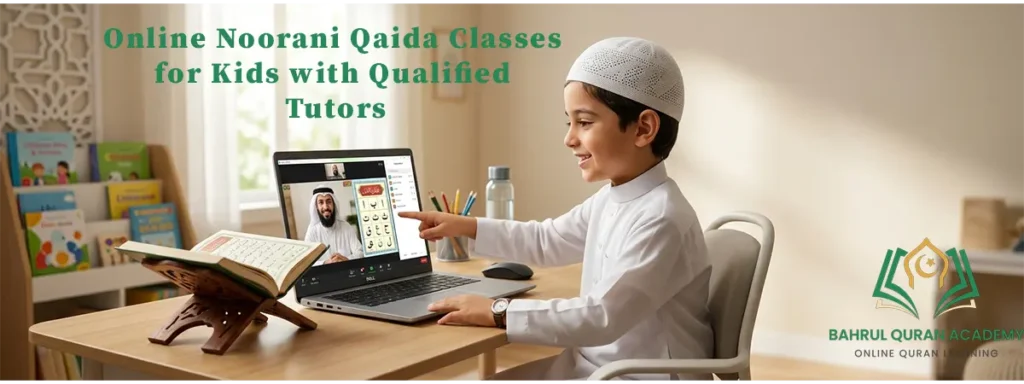
Noorani Qaida Online Classes for Kids – Help Your Child Learn Quran Reading at Home
Every parent wants their child to recite the Quran with confidence and correct pronunciation. Yet finding the right starting point is often the biggest challenge. Noorani Qaida online classes for kids provide exactly that — a structured, step-by-step path from learning Arabic letters all the way to fluent Quran reading, delivered live from the comfort of home. Whether your child is four years old or ten, these online Quran classes for kids are designed to build a strong, lasting foundation.
Families across the UK, USA, Canada, Australia, and Pakistan are choosing Noorani Qaida online classes for kids because they combine expert teaching with modern flexibility. Your child gets one-on-one attention from a certified tutor, learns at their own pace, and joins sessions that fit your family schedule. This guide covers everything you need to know — from what the course includes to how to book your child’s first free lesson.
Understanding Noorani Qaida and Its Importance for Young Learners
Noorani Qaida is the most trusted primer for beginner Quran reading. It introduces children to Arabic letters, vowels, and basic Tajweed rules in a carefully sequenced order. Developed over a century ago by Molvi Muhammad Ludhianvi, it remains the global standard for Arabic alphabet learning and Quran preparation.
Noorani Qaida online classes for kids bring this proven curriculum into a modern, digital learning environment. Children benefit from the same structured content that has produced confident Quran readers for generations, now delivered through live video sessions with qualified teachers who understand how children learn. The combination of classical methodology and online convenience makes this the ideal solution for Muslim families worldwide.
Why Noorani Qaida Is the First Step Toward Accurate Quran Reading
Accurate Quran recitation is built on correct Arabic reading habits developed early. The Noorani Qaida teaches children to identify every Arabic letter in its isolated and connected forms. It drills the correct makharij — the precise articulation points for each letter — which protects children from developing mispronunciation habits that are difficult to correct later.
Many parents wonder why their child cannot simply start reading the Quran directly. The answer lies in pronunciation of Arabic letters. Letters like ظ, ذ, and ز sound deceptively similar to untrained ears yet come from completely different positions in the mouth and throat. Noorani Qaida online classes for kids address this from the very first lesson, building phonetic precision before any Quran reading begins.
Best Age for Children to Begin Noorani Qaida Lessons Online
Most children are ready to begin Noorani Qaida online classes for kids between ages four and seven. The young brain is exceptionally receptive to phonetic learning during these early years, making Arabic letter recognition faster and more natural at this stage than at any other age.
However, online Noorani Qaida course content is equally effective for older beginners. Children aged eight to twelve and even teenagers with no prior Arabic reading experience benefit enormously from starting with Noorani Qaida. Our teachers assess every new student individually to ensure lessons begin at exactly the right level — never too easy, never overwhelming.
How Noorani Qaida Supports Tajweed Skills and Quran Fluency
Tajweed basics are embedded throughout the Noorani Qaida curriculum, not added at the end. As children work through each lesson, they learn how letters interact within words — how short vowels (harakat) change sounds, how tanween modifies pronunciation, and how lengthening rules (madd) work in Quranic text.
Therefore, completing the Noorani Qaida does not just teach a child to recognise letters. It equips them with the Tajweed skills and fluency in Quran recitation needed to begin reading the Quran accurately from day one. This is why Noorani Qaida online classes for kids are the recommended starting point for every young learner — regardless of their background or prior exposure to Arabic.
A Look Inside Our Noorani Qaida Online Course for Children
Our online Noorani Qaida course is purpose-built for children aged four and above. It follows a clear progression from the Arabic alphabet through to connected reading, integrating pronunciation drills, Tajweed rules, and interactive exercises at every stage. Every session is live, personal, and tailored specifically to your child.
Parents who enroll their children in Noorani Qaida online classes for kids through our platform often describe the experience as completely different from what they expected. Lessons are engaging, the teachers are patient, and children genuinely look forward to each session. That is because we design every element of the course around how children actually learn — not how adults think they should.
A Progressive Learning Path from Arabic Alphabet Recognition to Reading
The step-by-step Quran learning structure of our course follows a clear, logical progression:
| What Your Child Learns |
|---|
| Stage 1 Arabic alphabet letters — isolated forms and names |
| Stage 2 Letters in connected forms — beginning, middle, and end positions |
| Stage 3 Short vowels — fatha, kasra, damma (harakat) |
| Stage 4 Tanween (double vowels) and sukoon |
| Stage 5 Madd letters and lengthening rules |
| Stage 6 Compound letters and special Quranic symbols |
| Stage 7 Short Quranic phrases with foundational Tajweed applied |
Each stage consolidates fully before the next begins. No child in our Noorani Qaida course for kids is rushed through material before they are genuinely ready to move forward.
Personalized One-on-One Sessions Explained
Every child enrolled in Noorani Qaida online classes for kids receives completely personalised, one-on-one teaching — not group lessons. The teacher focuses entirely on your child during every session, monitoring pronunciation in real time and correcting errors the moment they appear.
This individual attention is what separates a quality online Qaida classes for kids experience from a classroom setting. A teacher working with one child can immediately adapt their approach when a student struggles, introduce extra practice for a difficult letter, or accelerate through material when a child demonstrates strong retention. The result is faster, more accurate, and more confident learning.
Convenient Class Timings Designed for Busy Families
We know that busy families need maximum flexibility. Therefore, flexible online Quran lessons for kids are available seven days a week across morning, afternoon, and evening time slots. Whether you are in London, Toronto, Houston, Sydney, or Karachi — a suitable session time is available for your family.
Class timings for Noorani Qaida online classes for kids can also be rescheduled with advance notice whenever your family schedule changes. There are no rigid timetables, no penalties for adjustments, and no expired lesson packages. Your child’s learning journey fits around real family life.
Meet the Experienced Quran Teachers Guiding Your Child
The teacher is the most important factor in any child’s learning experience. That is why every tutor who delivers Noorani Qaida online classes for kids on our platform is carefully selected, thoroughly vetted, and continuously evaluated. We do not compromise on teacher quality — ever.
Our expert Quran tutors for kids hold formal qualifications from respected Islamic institutions and bring years of experience specifically in teaching children online. They understand child psychology, attention spans, and the creative techniques needed to keep young learners engaged session after session.
Qualified Instructors with Ijazah Certification and Teaching Expertise
Every teacher delivering Noorani Qaida online classes for kids holds a verified Ijazah in Quran recitation with Tajweed. Ijazah is the highest scholarly credential in Quranic education — an unbroken chain of authority connecting each teacher’s recitation directly back through generations of scholars to the Prophet Muhammad ﷺ.
In addition to their Ijazah, our teachers hold formal degrees in Islamic studies and have completed specialised training in teaching Arabic and Quran to children in an online environment. This combination of religious authority and modern pedagogical skill makes them exceptionally equipped to guide your child through the learn Noorani Qaida online journey.
Choosing the Most Suitable Tutor for Every Student
We match every child with the most suitable teacher based on age, current level, learning personality, and your family’s preferences. This matching process happens before the first session, so your child begins learning with the right teacher from day one of their Noorani Qaida online classes for kids.
However, we understand that teaching relationships are personal. If at any point you feel your child would benefit from a different teaching style or personality, we make the change quickly and without any complication. Your child’s comfort and consistent progress are always our first priority.
Dedicated Female Teachers for Girls and Younger Children
Many Muslim families specifically request a female Quran teacher for their daughters and for younger children. We fully support this preference and have built a dedicated team of Ijazah-certified female teachers who specialise in delivering Noorani Qaida online classes for kids in a warm, safe, and nurturing environment.
Female teachers are particularly effective with shy learners and younger girls who open up more naturally in a comfortable setting. Parents consistently report that children with female tutors settle into their Noorani Qaida online classes for kids faster and show stronger early progress than in mixed or group settings.
Monitoring Your Child’s Learning Progress Every Step of the Way
When you enroll your child in Noorani Qaida online classes for kids, you are not just signing up for lessons — you are joining a fully supported learning programme. We keep parents informed and involved at every stage, because we know that a child whose parents are engaged in their learning journey progresses significantly faster.
Our reporting and communication system gives you full visibility into your child’s Quran reading journey from the very first lesson to the completion of the course.
Parent Updates, Assessments, and Performance Reviews
After every lesson in our Noorani Qaida online classes for kids, the teacher sends a brief progress note directly to parents via WhatsApp or email. These updates highlight what was covered in the session, what the child did particularly well, and which areas need additional home practice.
In addition, formal monthly assessments evaluate pronunciation of Arabic letters, Tajweed rules retention, and overall reading fluency. These are shared as written reports so you have a clear, documented record of your child’s development. Parent review calls every four to six weeks allow for a deeper conversation about progress, goals, and any adjustments to the learning plan.
Improvements Children Commonly Achieve During the First Few Weeks
Most children enrolled in Noorani Qaida online classes at home begin showing clear improvement within the first two to four weeks of regular lessons. Parents commonly report these milestones:
- Week 1–2: Confident recognition of all 28 Arabic letters in isolated form
- Week 3–4: Reading letters with harakat (short vowels) without hesitation
- Week 5–6: Reading compound letters and simple words with growing accuracy
- Week 8–10: Demonstrating clear Tajweed awareness and improved pronunciation in Quran recitation
These timelines vary between children. However, consistent daily home practice of just ten to fifteen minutes dramatically accelerates how quickly a child moves through the Noorani Qaida course for kids.
Encouraging Regular Practice and Maintaining Student Interest
Our teachers use fun and interactive Quran classes for children to sustain engagement across every session. Repetition is essential for Arabic reading for kids, but it must be delivered creatively to hold a child’s attention. Our tutors use visual aids, storytelling, pronunciation games, and genuine positive reinforcement to make every lesson something children genuinely look forward to.
We also provide simple home practice cards for parents. These short daily exercises — taking just five to ten minutes — reinforce the lesson content between sessions. Regular at-home practice is the single most powerful predictor of how quickly a child completes their Noorani Qaida online classes for kids and begins reading the Quran confidently.
Enroll in Noorani Qaida Online Classes for Kids with a Free Trial
Getting started with Noorani Qaida online classes for kids is simple, fast, and completely risk-free. We offer every new family a complimentary trial lesson so your child can experience real, live teaching before you make any commitment. There is no payment required for the trial, and there is absolutely no obligation to continue.
Thousands of families across the UK, USA, Canada, Australia, and Pakistan have started their child’s Quran reading journey through our platform. Students include complete beginners with no Arabic exposure, children who know some letters but need structured guidance, and children switching from other programmes who want a fresh start. Every child is welcomed exactly where they are.
Three Easy Steps to Register Your Child
Step 1 — Complete the enrollment form
Enrollment is very simeple and easy just click Get Free Trial button. Share your child’s name, age, current level, and your preferred class timing and teacher preference.
Step 2 — Get matched with the right teacher
Our team reviews your information and selects the most suitable tutor for your child from our certified team. You are informed of the match before the first session.
Step 3 — Attend your free trial class
Your child joins a live, one-on-one, thirty-minute trial session. The teacher assesses their current level and begins building a personalised learning plan. You receive written feedback the same day.
What Happens During the Complimentary Trial Lesson
The free trial for Noorani Qaida online classes for kids is a real, structured lesson — not a sales call. The teacher greets your child warmly, carries out a friendly level assessment, and introduces the first appropriate concepts for your child’s starting point. Your child will learn something new in the very first session.
After the lesson, you receive a written teacher report covering your child’s current level, learning strengths, areas for development, and a recommended learning plan. Most families choose to continue after the trial because they see immediately how effective, comfortable, and engaging the experience is for their child. Book your free trial today and take the first step in your child’s Quran reading journey.
What is Noorani Qaida and why is it important for children learning to read the Quran?
Noorani Qaida is a structured beginner primer teaching Arabic letters, short vowels, and basic Tajweed rules in a step-by-step sequence. It builds the correct pronunciation foundation every child needs before starting Quran recitation.
What is the best age to start Noorani Qaida online classes for kids?
Children as young as four can begin. The ideal age range is four to seven years. However, older children and adults with no prior Arabic reading experience also benefit greatly from this foundational course.
How long does it take to complete the online Noorani Qaida course?
Most children complete it in three to six months with two to three sessions weekly. Children who practice ten to fifteen minutes daily at home typically progress significantly faster.
Are the Quran teachers Ijazah-certified and qualified to teach children?
Yes. Every teacher holds a verified Ijazah in Quran recitation and Tajweed, plus formal Islamic studies qualifications and specialised experience in teaching children online.
What devices and technology are needed for online Noorani Qaida classes?
A smartphone, tablet, or laptop with a stable internet connection and a working camera is sufficient. We use Zoom or Skype, both of which are free and simple for children to use.